The other side hasn’t done what the contract says. What can I do?
The other side hasn't done what the contract says. Here's how to tell if it's a breach, what to do first, what you can claim, and which court or process it goes to.
Civil · Chrysandy Lai

You agreed on something. You did your part, or you were ready to. The other side didn’t. Maybe the goods never arrived, the renovation stopped halfway, the payment is three months late, or the supplier simply went quiet.
When that happens, there is usually a breach of contract in Malaysia, and the law gives you real options. But the options depend on the kind of breach, what you can prove, and what the contract itself says about disputes. The first moves you make matter more than most people realise.
Here’s how to work out where you stand, and what to do about it, in the order it usually happens.
Table of Contents
Is this actually a breach of contract in Malaysia?
A breach of contract happens when one party fails to do what the contract requires: they don’t do it at all, they do it late, or they do it badly. Contracts in Malaysia are governed mainly by the Contracts Act 1950.
Three questions decide whether you have a breach worth acting on.
Was there a contract at all? Section 10(1) of the Contracts Act 1950 says all agreements are contracts if they are made by the free consent of parties competent to contract, for a lawful consideration and with a lawful object, and are not expressly declared void. Nothing in that section requires a signed document. So an agreement made in an exchange of emails, over WhatsApp, or face to face can be binding, as long as those requirements are met. (There are exceptions. Some agreements, such as certain dealings in land, have formal requirements of their own.) The real difficulty with informal agreements usually isn’t whether they count. It’s proving what was agreed.
What did it actually require? Look at the express terms: what was written or said, such as the price, the deadline, the specification, the payment schedule. There may also be implied terms, obligations so obvious or necessary that the law reads them in even though nobody wrote them down, such as doing the work with reasonable care.
Did they fall short of it? Compare what was promised with what happened. “It isn’t what I hoped for” isn’t the test. “It isn’t what we agreed” is.
If the answer to all three is yes, you very likely have a breach. The next question is how serious it is.
How serious is it? The kinds of breach that matter
Not every breach of contract in Malaysia lets you walk away from the deal. Lawyers sort breaches into several categories, and competing guides tend to list all of them. Labels such as “minor” and “fundamental” come mostly from case law rather than from the Contracts Act itself, and the courts look at the facts of each case. For deciding what to do next, the distinction that matters most is simpler: can you end the contract, or only claim for the loss?
A minor breach. Something was done, but not quite right: a small defect, a short delay, a detail out of specification. In general, you can claim compensation for the loss it caused, but it is unlikely to justify walking away from the whole deal.
A serious (fundamental) breach. The failure goes to the heart of what you bargained for. The goods are unusable, the work is so defective it has to be redone, or a core obligation was ignored entirely. A breach like this may entitle you to end the contract and claim your losses. Whether yours is serious enough is a question of fact and of what the contract says.
When they refuse to perform at all. Section 40 of the Contracts Act 1950 says that when a party has refused to perform, or has disabled himself from performing, his promise in its entirety, the promisee may put an end to the contract, unless he has signified, by words or conduct, his acquiescence in its continuance. Firms call this “anticipatory” breach when it happens before performance is due. Note the last part: if you carry on as though the contract is still alive, you may lose the right to end it.
When it’s late. Section 56 deals with this. If time is essential to the contract and a party fails to perform by the specified time, the contract (or the part not yet performed) becomes voidable at the promisee’s option. If time wasn’t essential, the contract doesn’t become voidable, but the promisee is entitled to compensation for any loss caused by the delay. And there’s a trap: if you accept late performance without giving notice, at the time of acceptance, that you intend to claim compensation for the delay, you can’t claim it afterwards. If something is delivered late and you accept it, say in writing that you reserve your right to claim.
A word of caution: deciding to end a contract is itself a legal step, and getting it wrong can turn you into the party in breach. If you stop paying, stop work, or terminate over a breach that turns out to be minor, the other side may be the one with the claim. When in doubt, get advice before you terminate, not after.

What to do first
What you do in the first few weeks shapes how strong your position is later, long before any court is involved. A practical sequence:
- Stop and reread the contract. Read all of it, including the boilerplate at the back. Look specifically for the payment and delivery terms, any termination clause, any notice requirements, any liquidated damages clause, and any clause about how disputes are resolved.
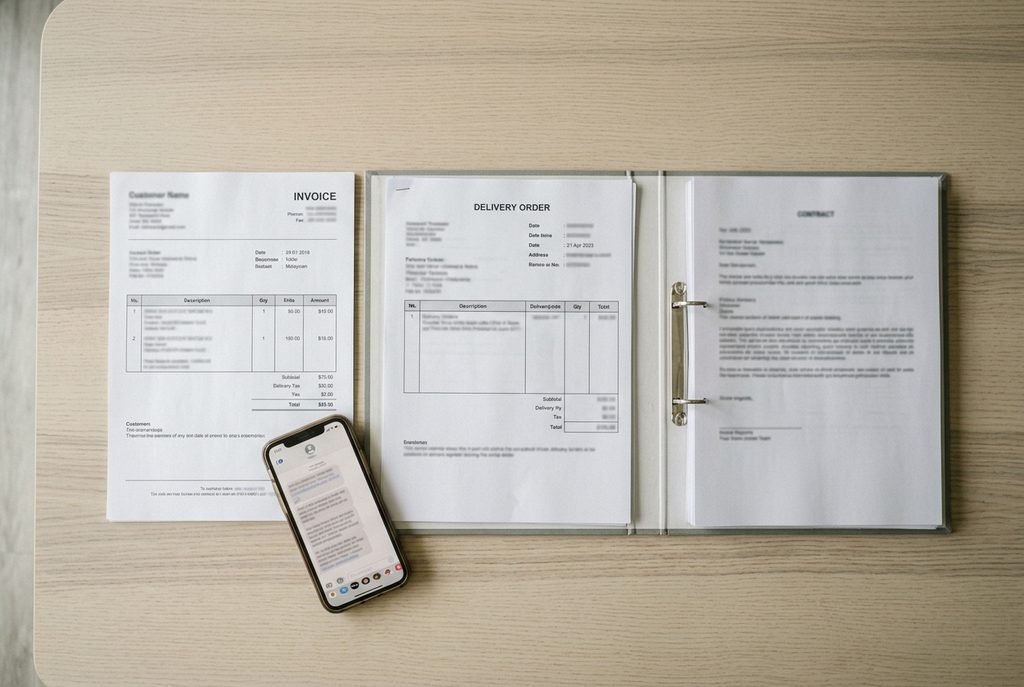
- Gather the evidence while it’s fresh. That means the contract, quotations, invoices, delivery orders, receipts, photos of defective work, and every message about the deal. Export WhatsApp chats and emails rather than relying on screenshots alone. Put it all in one place in date order.
- Write down what happened. Make a simple timeline: what was agreed, when, what was delivered, and what wasn’t. This is the most useful document you can bring to a lawyer, and it’s much easier to write now than in six months.
- Check the dispute clause. Many commercial contracts say disputes must go to arbitration rather than court, or must first go through negotiation or mediation. If yours does, that shapes everything that follows. (More on that in what an arbitration clause in your contract means.)
- Don’t stop performing on your side without advice. Withholding payment or downing tools can feel like leverage. It can also hand the other side a breach of their own to point to.
- Put the complaint in writing, calmly. A clear message setting out what was agreed, what hasn’t been done, and what you want (completion, correction, or payment) by a reasonable date. Keep it factual. Anything angry will be read out later in a very different tone.
- If that doesn’t work, send a letter of demand. A formal letter of demand, usually from a lawyer, puts your claim on record, says exactly what you want and by when, and gives the other side a clear last chance to put things right before you take it further. Check your contract first, because some contracts require a particular form of notice before you can claim or terminate. (From the other side of the table: what to do when you receive a letter of demand.)
Following steps 1 to 5 puts you in a stronger position whichever way the dispute goes, whether it settles at step 6 or 7 or ends up in front of a judge.
If you’re the one being accused of breach
The same steps apply in reverse. Reread the contract before you respond, because the other side’s complaint may rest on a term that doesn’t say what they think it says. Gather your own evidence, especially anything showing that you performed, that they changed the scope, or that they caused the delay themselves. Reply in writing, calmly, and don’t admit to anything in a hurry. If a formal letter of demand has arrived, the reply can be framed “without prejudice,” so you can negotiate without conceding the claim. And don’t ignore it: silence rarely makes a contract dispute go away.
What you can claim
People asking about remedies for breach of contract usually want a number: how much compensation can I get? The law doesn’t work from a fixed scale. Compensation is generally meant to put you in the position you would have been in if the contract had been performed, not to punish the other side, and it is assessed case by case.
Damages. This is the most common remedy. Section 74 of the Contracts Act 1950 says that when a contract has been broken, the party who suffers by the breach is entitled to compensation for any loss or damage caused to him, which naturally arose in the usual course of things from the breach, or which the parties knew, when they made the contract, to be likely to result from it. Compensation isn’t given for remote and indirect loss. In practice, a claim usually includes:
- the cost of getting the job done properly by someone else
- money you’ve paid for something you didn’t receive
- losses that flowed directly from the failure, such as wasted costs or lost business, if you can prove them.
You’re expected to limit the damage. The Explanation to section 74 says that in estimating the loss, the means which existed of remedying the inconvenience caused by the non-performance must be taken into account. In plain terms: if you could reasonably have reduced your loss, for example by finding a replacement supplier, and didn’t, you generally can’t claim for the part you could have avoided. Keep a record of what you did to keep the loss down.
Liquidated damages. Some contracts set out in advance what’s payable for a particular breach, often a fixed sum per day of delay. Under section 75, where a sum is named in the contract as payable on breach, the party complaining of the breach is entitled to reasonable compensation not exceeding the amount named. The Federal Court’s 2019 decision in Cubic Electronics v Mars Telecommunications dealt with how that works. As commentators summarise it, the innocent party must show the breach and the clause, and the burden then shifts to the other side to show that the sum is unreasonable. The court said there is no necessity to prove actual loss in every case, and that reasonable compensation isn’t confined to actual loss. The same approach applies to a forfeited deposit. So a clause like this can be useful to the innocent party, but a court can still reduce a figure that is out of proportion.
Specific performance. Sometimes money isn’t the right answer, for example where the contract concerns a particular piece of land. A court can order the other party to actually do what they promised, under the Specific Relief Act 1950. It’s a discretionary remedy, and courts are generally slower to order it where money compensation would be enough.
An injunction. A court order stopping someone from doing something, such as breaching a confidentiality or non-competition term, or disposing of the subject matter of the dispute.
Ending the contract and recovering what you paid. Where you are entitled to end the contract, money you paid for something you never received can generally be claimed back as part of your losses, alongside your other losses. What you can recover depends on the facts and the contract, so this is one to check with a lawyer.
“The work is done, but payment hasn’t come”
This is a situation almost every business owner and freelancer will recognise: you’ve delivered, they haven’t paid. Because the amount is usually fixed by the contract, it is often simpler than other breaches, unless the other side says the work was defective or incomplete.
A few points specific to it:
- The invoice is your strongest document, together with whatever shows the work was delivered and accepted: a signed delivery order, a completion certificate, a message saying “received, thanks”.
- An agreed price is usually simpler to claim than damages. You’re claiming a fixed sum that was agreed, so you generally don’t have to prove what you lost. If they say the work was defective, expect that to be argued.
- If the debtor is a company, the Companies Act 2016 provides that a company is deemed unable to pay its debts if it fails, within 21 days of a statutory demand served on it, to pay a debt of more than RM10,000 (section 466; check the current figure before relying on it, because it was changed temporarily in 2020). That can lead to a winding-up petition, which is a powerful step. But the court can restrain a petition where the debt is genuinely disputed on substantial grounds, so it fits debts the company has no real answer to. It isn’t a substitute for a claim where the amount is contested.
- If you’re in construction, unpaid work under a construction contract may come under the Construction Industry Payment and Adjudication Act 2012 (CIPAA). CIPAA has its own faster adjudication process, which is worth knowing about before you start an ordinary court claim.

Court, arbitration, or a negotiated settlement?
When a demand doesn’t resolve things, there are several ways forward. Which one applies depends partly on your contract and partly on the amount involved.
Which court? For ordinary civil claims, the amount at stake decides where the case starts (the Judiciary’s own summary of court jurisdiction sets out the limits):
| Claim amount | Where it usually starts |
|---|---|
| Up to RM5,000 | Small claims procedure at the Magistrates’ Court (Order 93 of the Rules of Court 2012), where the parties generally act for themselves |
| Under RM100,000 | Magistrates’ Court |
| RM100,000 to RM1,000,000 | Sessions Court |
| Above RM1,000,000 | High Court |
Arbitration, if the contract says so. If your contract has an arbitration clause, section 10 of the Arbitration Act 2005 says that if you start a court case, the other side can apply to the court to stay it. The court must then stay the proceedings and refer the parties to arbitration, unless it finds that the arbitration agreement is null and void, inoperative or incapable of being performed, or that there is in fact no dispute. The application has to be made before the applicant takes any other steps in the court case, so timing matters. Arbitration is more private than court and the parties have more say over the process, but the parties pay the arbitrator’s fees and the costs of the process.
Mediation and negotiation. A dispute can be settled at any stage, including after a case has started. A negotiated or mediated settlement can preserve a business relationship in a way that a judgment rarely does, and it gives both sides more control over the outcome.
What it costs. Fees can’t be published here, and they depend heavily on how the other side responds. One thing worth knowing: costs in civil cases are generally awarded against the party who loses, but the court decides the amount, and it may not cover everything the winner actually spent. So even a strong claim carries some cost risk. Weigh that against what you’re claiming before you decide how far to take it.
Winning isn’t the same as being paid. If the other side doesn’t pay after judgment, there are enforcement steps: seizing assets, garnishing bank accounts, and for companies, winding-up. Whether they’re worth taking depends on whether the other side has anything to recover from. It’s a good question to ask before you sue, not after.
Is there a time limit?
Yes. Under section 6(1)(a) of the Limitation Act 1953, a claim founded on a contract in Malaysia generally has to be brought within six years from when the cause of action arose, which is usually the date of the breach. There are exceptions, and the exact starting point can be arguable, so treat six years as an outer limit to check properly, not a deadline to plan around.
In practice, the bigger risk is rarely the legal deadline. It’s that evidence goes missing, people forget, and companies change hands or run out of money. Acting within weeks rather than years is what keeps a claim strong.

Frequently asked questions
What are the four types of breach of contract?
Guides usually list four types of breach of contract: minor (partial) breach, material breach, fundamental breach, and anticipatory breach, where a party makes clear in advance that they won’t perform. What matters most in Malaysia is whether the breach is serious enough to let you end the contract, or only entitles you to compensation. That depends on what was breached, not on the label.
How much compensation can you get for a breach of contract in Malaysia?
There’s no fixed amount: under section 74 of the Contracts Act 1950, compensation for a breach of contract aims to put you where you’d have been had the contract been performed, covering losses that flowed naturally from the breach or that both sides knew were likely to result. The Explanation to section 74 requires the means of remedying the problem to be taken into account, so take reasonable steps to limit your loss.
Is a verbal or WhatsApp agreement a binding contract in Malaysia?
Often, yes: under section 10(1) of the Contracts Act 1950, agreements are contracts if made by the free consent of competent parties, for a lawful consideration and with a lawful object, and the section doesn’t require a signed document. An agreement made orally, by email, or over WhatsApp can be enforceable on that basis. Some agreements, such as certain land dealings, have formal requirements. The harder part is usually proving exactly what was agreed, so keep every message.
Can I stop paying or stop work if the other side is in breach?
Only if the breach is serious enough to justify ending the contract, and that’s risky to decide without advice. The Contracts Act lets you end a contract where the other side refuses to perform at all (section 40), and treats the contract as voidable at your option where a deadline was essential and was missed (section 56). If you stop performing over a breach that turns out to be minor, you may become the party in breach yourself. Check the contract’s termination terms first.
Where to start
If the other side hasn’t done what the contract says, the two things that matter most right now are the contract itself, and everything that shows what was agreed and what actually happened. Get those in one place, check the dispute clause, and put your complaint in writing. Everything else follows from there.
Every breach of contract in Malaysia turns on its own documents. If it would help to have someone read the contract and the messages and talk through the options, message me.
This article is general information about Malaysian law, not legal advice. Reading it or contacting me does not create a solicitor–client relationship.

Chrysandy Lai
Advocate & Solicitor
Chrysandy Lai is an Advocate & Solicitor admitted in both Malaysia and New Zealand, and principal of Messrs Chrysandy Lai & Qiu in Seremban. Her practice covers wills and estates, civil and commercial disputes, and arbitration.